You Can Afford It. That’s Not the Question.
A different way to think about spending: use the Rule of 72 and the 4% rule to translate a purchase today into possible retirement spending tomorrow.
Finance Dad
7 min read

Would you still buy it if you could see what else that money might do?
For a lot of us, a $100 purchase doesn’t require much thought. We have the money. We want the thing. We buy it.
I do it, too. I spend money on things for my kids that make them happy for a few weeks and then disappear into the bottom of a toy bin. Sometimes I know that’s exactly how it will go, and I’m happy to buy them anyway.
But I’d like to be as deliberate about the alternative. What if I invested that money instead? And more usefully: what could it let me spend when I retire?
The Rule of 72 and the 4% rule become much more interesting when you put them together. One helps you picture how your money could grow. The other helps you picture what it could let you spend.
First, give $100 some time
You’ve probably seen a compounding chart: a line that starts slowly, bends upward, and eventually gets your attention. The growth earns growth of its own.
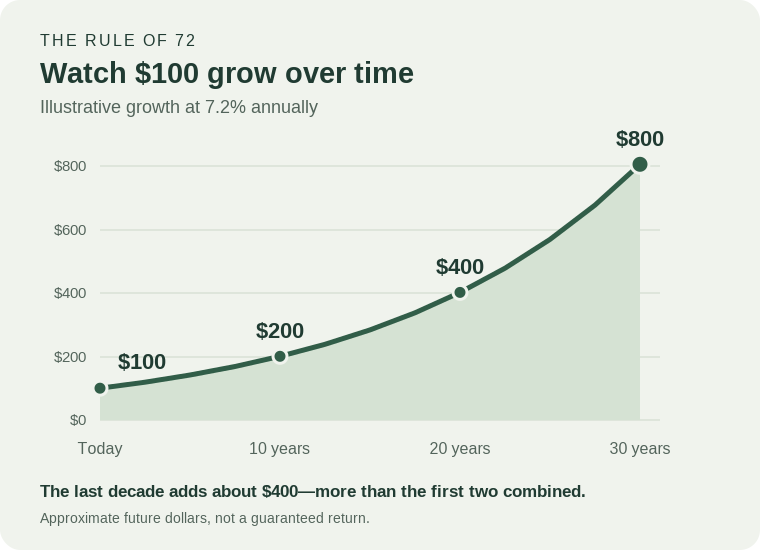
The Rule of 72 gives you a quick estimate of how long a doubling takes. Divide 72 by the annual return you assume. At 7.2%, that’s about ten years.
So $100 becomes roughly $200 after ten years, $400 after twenty, and $800 after thirty. In that last decade alone, it adds more dollars than it did in the first two combined.
That’s a satisfying curve. But $800 is still just a number. Let’s give it a purpose.
Next, turn that growth into spending
Here’s where the 4% rule comes in. It’s a simple starting point for thinking about retirement: how much could you spend if you withdrew 4% of your investments in the first year?
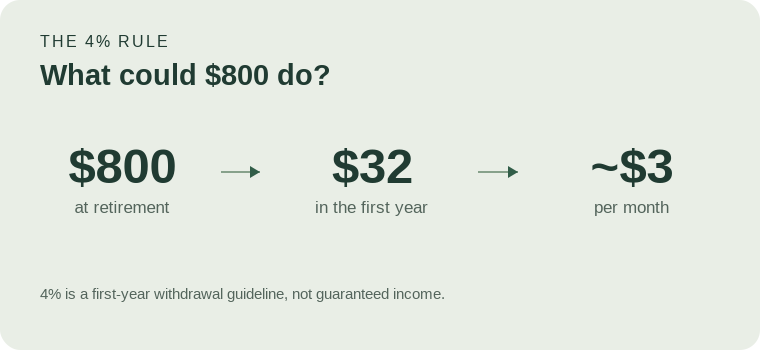
For this comparison, we only need that first step. Four percent of $800 is $32 a year, or about $2.67 a month.
That’s a starting amount for retirement spending. Under the rule, you keep taking withdrawals in later years, adjusting that dollar amount for changes in the cost of living. The aim is to support spending throughout retirement, though the outcome depends on how your investments perform and how long retirement lasts.
$800 at retirement → $32 in first-year spending → $2.67 per month.
Now that $800 has a purpose: a little more spending money each month when you retire.
And honestly? Faced with that comparison, I might still take the thing today. A purchase I enjoy can easily be worth more to me than a few dollars a month in retirement.
But there’s another question: how often am I making this choice?
Using the same thirty-year example, investing $5 instead of spending it could add about 13 cents to that starting monthly retirement amount. For $20, it’s about 54 cents. Each one looks tiny on its own. But we make these little decisions again and again. As the money we invest has time to compound, those small additions can build into something meaningful.
Now, put the two together
Say there’s $100 of spending each month you could happily do without. Investing that amount for thirty years at the same assumed 7.2% annual return would build about $121,000. You’d contribute $36,000; roughly $85,000 would come from growth.
At a 4% starting withdrawal rate, that’s about $404 a month to start your retirement spending. That’s where the little amounts begin to feel much less little.
That makes the choice more interesting to me. What am I getting from those purchases each month? And how much would I value the extra spending money later?
Here’s that $100-a-month example. Feel free to change the amount or the years. You don’t need to figure anything else out to give it a try.
Let the numbers inform the choice
The internet loves to tell you to stop buying Starbucks. If that coffee is something you look forward to every morning, enjoy it. You might look at what investing the money could do and still happily choose the coffee. That’s a perfectly reasonable choice.
Where I find this useful is the spending I barely enjoy: the recurring charge I’ve stopped noticing, or the things I buy because buying them has become a habit.
You may look at your numbers and decide the purchases are worth it. You may find one you’d happily give up. Both answers tell you something useful.
“Can I afford it?” tells me whether I can buy it. This comparison helps me decide whether I want to.
Give one monthly expense a second look
Once a month, take five minutes to look for one opportunity. A few places to start:
- Streaming services. Add up your subscriptions. Which ones do you actually watch, and which are you paying for just in case?
- Coffee. Look at what you spent this month. If you loved every cup, great. Are there any you bought mostly out of habit?
- Insurance. Maybe you’ve been putting off asking about a better rate or comparing quotes for the same coverage. What could that call save you each month?
Credit card interest you’ve been meaning to tackle deserves a look, too. Paying down that balance is a separate decision; the example above shows what money could do once it’s available to invest.
Then pick one thing and try this:
- Work out what you could actually free up each month. If a better insurance rate would save $25, use $25—not your whole premium.
- Try that amount in the example above, with your years until retirement. See what it could help you spend later.
- Decide whether the change feels worthwhile. If it does, cancel that unused subscription, make the call, or change the habit—and give the money you free up a purpose.
You don’t need to overhaul your spending. Start with one choice you can explain to yourself.
Did the comparison change how you saw a purchase—or confirm it was worth it? Leave a comment or send me a message. I’d like to hear what you found.
A note on the numbers
This example assumes 7.2% effective annual growth and fixed deposits at the end of each month. The retirement spending figure is 4% of the final balance, divided by twelve. Figures are shown in future dollars, without adjustments for inflation, taxes or fees. They illustrate a possibility, rather than predict your results.
The 4% rule is a withdrawal guideline, not an investment return or guaranteed income. It was developed around a roughly thirty-year retirement, with the initial dollar withdrawal adjusted for inflation afterward. This example shows only the first year’s spending; it doesn’t test how long a portfolio will last.
Read more: The Rule of 72 · The 4% rule.
Comments
No comments yet. Be the first to share your take.
Leave a comment
Comments are reviewed before they appear. Please don't share account numbers or other sensitive financial details.